
Rei·ki
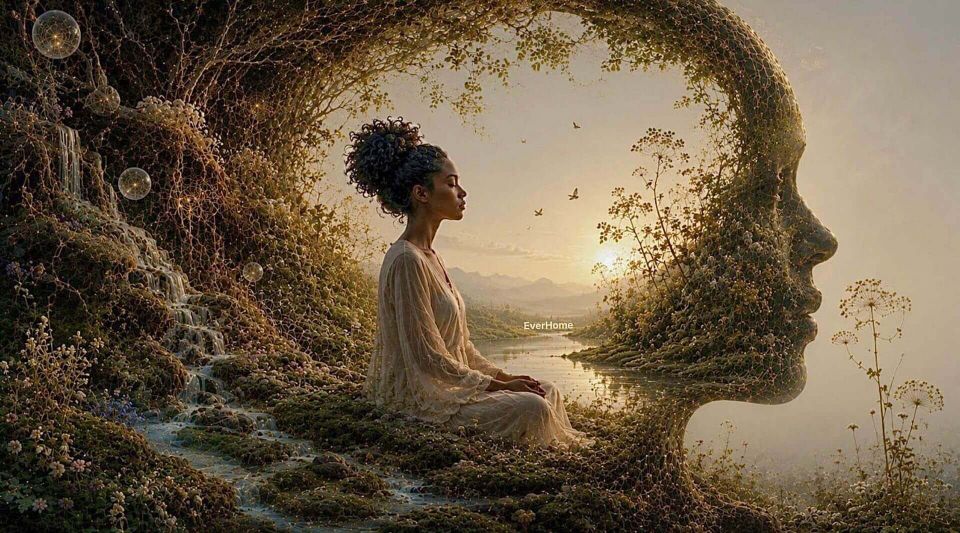
Reiki (RAY-kee)
- The innate, cosmic spiritual wisdom and vital energy that animates all existence, serving as both a diagnostic and healing current when consciously accessed.
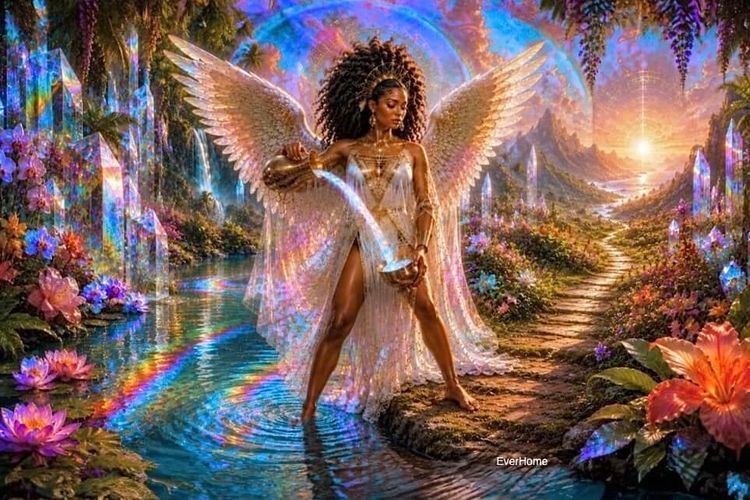
- The practice of channeling universal life-force energy through the hands and intentional presence to restore balance, harmony, and flow within a living being's subtle body.
(country of origin: Japan)
I recently met with a Reiki practitioner who has helped guide my body through profound healing, bringing my system into greater alignment in a shorter period of time than many of the other treatment modalities I have explored. During one of our post-session conversations, she caught me entirely off guard by sharing information about both my personal history and my ancestral lineage that I had never disclosed to her. The specificity of her intuitive knowing could not be ignored, and it immediately triggered one of my favorite intellectual pursuits: mapping logic onto fluid, intuitive ways of understanding the world.
NO MIND
Mushin (無心) is a Japanese concept that literally translates as “no mind,” “without mind,” or “no fixed mind.” It refers to a state in which the mind is free from attachment, self-consciousness, hesitation, and compulsive thought, allowing perception and action to arise naturally and without obstruction. Although mushin is not originally or exclusively a Reiki term, many practitioners describe entering a comparable state during treatment.
Rather than attempting to analyze or direct what unfolds, practitioners quiet the analytical mind through meditation, breath, and focused presence until their awareness becomes receptive instead of interpretive. In this state, they often describe themselves as functioning like a mirror or a radio receiver attuned to the energetic field of the person before them. This is often described as allowing oneself to become a channel.
In the spiritual philosophy that informs Reiki, consciousness is understood to be non-local — existing beyond the confines of the physical brain and unbound by the linear progression of past, present, and future. Perceptions arise independently of inference, emerging instead as immediate, holistic knowing. However, this idea is not unique to Reiki. I use it here simply as an entry point for exploring broader, cross-cultural understandings of consciousness that are rooted in fluid, non-linear frameworks.
Although the language and symbolism vary across traditions, many describe a shift from ordinary cognition into a quieter mode of awareness in which subtle forms of perception become more accessible. What fascinates me is how this shift appears to converge with the capacity that some practitioners have to receive information about an individual’s history or ancestral lineage. It was through a deeper exploration of the energetic field of the body — often referred to as the aura — that this relationship began to come into clearer focus for me.
LARGER WEB OF EXISTENCE
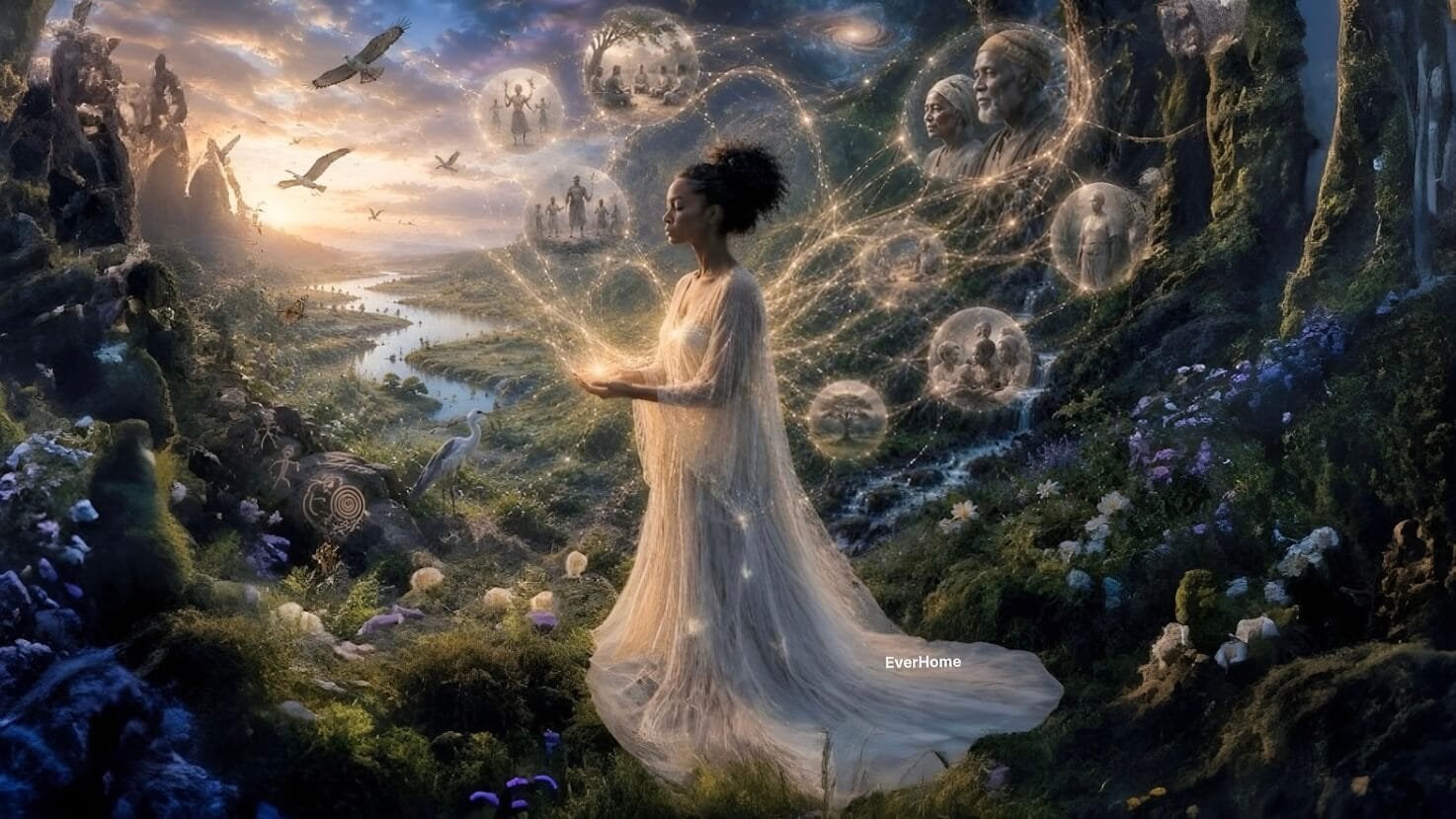
The traditions I encountered throughout my research consistently challenged the notion of the self as an isolated individual. Instead, across many non-Western spiritual frameworks, the human being is understood as existing in continuous relationship with ancestors, community, the natural world, and a broader field of consciousness. Lived experience (including, in some traditions, experiences extending beyond a single lifetime), ancestral lineage, or one’s place within a larger web of existence are understood to leave enduring imprints.
Just as biological inheritance transmits physical characteristics through DNA, many of these traditions understand the subtle body — the non-physical dimension of the human being through which vital energies are believed to operate — to transmit memory, unresolved wounds, and inherited capacities. Therefore, a practitioner who connects with the energetic field is understood to perceive more than the individual alone. Some believe that ancestral experiences continue to resonate within the present, revealing patterns that can be perceived intuitively.
BLOODLINE MEMORY
Across many Indigenous African spiritual traditions — including numerous Bantu cosmologies and Zulu spiritual practices — the individual is understood not as an autonomous being, but as one node within a much larger network of vital force extending across generations. Because life itself is understood as fundamentally relational, ancestors remain active participants in the unfolding life of the family, making the living individuals present expressions of an unbroken continuum. The past is not left behind; it remains an active dimension of the present. Through ritual, remembrance, dreams, and divination, the relationship between ancestors and descendants is continually renewed, reflecting the belief that lineage is not merely a record of those who came before, but a living reality that continues to inform and shape the present.
Although these African traditions differ profoundly in their theology, ritual practice, and cultural context, they converge on the idea that the individual is not the primary container of consciousness or experience. Reiki frames this through concepts such as the subtle body and an interconnected energetic field. What practitioners perceive is not simply the individual standing before them, but a broader field of relationships that gives shape to that person’s present reality.
KARMIC IMPRINTS
Tibetan Buddhist and Bön traditions describe the human being as comprising both a physical body and an energetic body consisting of channels, winds, and vital essences that together constitute the subtle anatomy through which body, mind, and consciousness interact. Rather than viewing the past as something permanently left behind, these traditions teach that previous actions leave karmic imprints. Karma is not understood as reward or punishment imposed from outside, but as a process through which every intentional action leaves behind a formative residue that continues to influence the individual, shaping how they perceive reality, respond to experience, relate to others, and participate in the unfolding of their own life.
THE CONCEPTUAL BRIDGE
The thread connecting these traditions is not a shared vocabulary, but a shared premise: human experience cannot be fully understood through material reality alone. What unites them is the conviction that the deepest forces shaping a human life often exist beyond what can be seen, measured, or reduced to biology. Whether through Reiki, Tibetan practices, or Indigenous African systems of divination, the objective is to perceive dimensions of a person’s condition that are believed to exist beneath the surface of ordinary awareness and to cultivate ways of attending to these subtler patterns. All begin with the possibility that meaningful information about a person exists beyond what they consciously reveal.
A RICHER INHERITANCE
My experience with the Reiki practitioner, followed by my exploration of these distinct spiritual traditions, reawakened a deeper intention behind my healing — one that extends beyond the regulation of my nervous system and the restoration of physiological well-being. It has become a commitment to interrupt the patterns of grief, fear, and suffering that have been carried through my family for generations. Whether described as ancestral memory, karmic imprints, or lingering energetic influences, these traditions share the view that inherited patterns need not remain permanent. Through conscious intention, what has been carried across generations can begin to transform, allowing a different inheritance to be passed forward.
The vision that continues to sustain me is that the process of healing might become the beginning of something much larger than myself, creating the conditions for future generations of my family to begin life with a more regulated and less burdened foundation than the one I received. More than anything else, that has always been the deeper purpose behind writing these reflections in the first place.
I find myself wondering what story an energy healer might one day perceive in one of my descendants. Rather than encountering generations of unresolved pain, I am clearing the path for them to encounter a lineage marked by greater freedom, resilience, and joy. Today, the work undertaken within my own body is dedicated to becoming their energetic inheritance — so that when someone eventually perceives their field, they encounter not only the story of what our family endured, but the story of our reclamation.