

bot·tle·neck | Part One
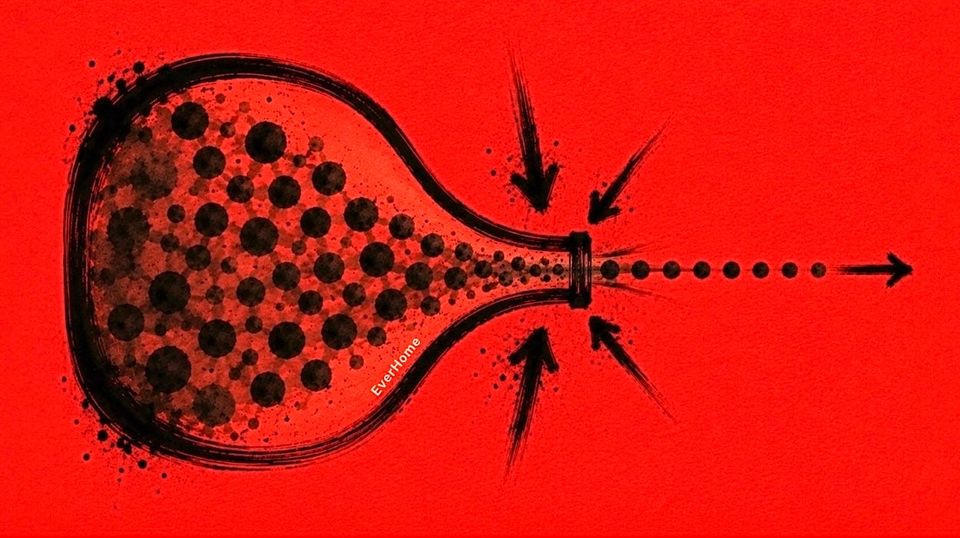
bottleneck (BOT-ul-nek)
- The underlying constraint (or interconnected pattern of constraints) that restricts a system’s ability to function, adapt, or progress.
- The limiting condition that defines the current capacity of a system and, once identified, reveals the most effective pathway for meaningful intervention.
THE ULTIMATE LIMITING CONDITION
When a complex entity begins to malfunction, multiple symptoms can arise simultaneously, frequently drawing corrective efforts toward the visible manifestations of the dysfunction rather than toward the underlying dynamics from which they emerge. The flaw in this approach is that these observable problems are usually the outward expressions of a more fundamental shared limitation—one that ultimately governs the capacity of the entire system.
A bottleneck is the ultimate limiting condition within a constricted system, preventing it from fully realizing its capacity. It functions as the locus of structural compression, where a single obstacle (or an interconnected pattern of forces) becomes the defining source of resistance.

No matter how much energy and effort—or how many resources—you invest in the rest of the structure, the high-tension trap created by this core restriction sends cascading effects far beyond where it exists, slowing growth and disrupting healthy functioning. It disproportionately governs the pace, resilience, and potential of everything connected to it, ultimately influencing the performance of the whole.
THE PANIC LOOP
As a bottleneck becomes more restrictive, additional symptoms begin to appear, because the underlying constraint remains in place. Over time, these downstream consequences compound, reducing the system’s overall resilience as an increasing share of its daily bandwidth is diverted toward managing immediate crises instead of eliminating the root cause from which they arise. The system quickly descends into a costly cycle of extinguishing today’s fires instead of preventing tomorrow’s. Perpetual firefighting leaves no opportunity to build higher, while the very foundation supporting that growth is being reduced to ash.
This panic loop, in which an organism expends nearly all of its vital capacity managing the immediate, traps the entire structure in a state of survival. Because survival mode is fundamentally an emergency response, it becomes increasingly costly the longer it persists. What begins as adaptive behavior gradually transforms into the very mechanism sustaining the system’s decline. The longer this loop persists, the less capacity the entity retains to interrupt it.
A TRAJECTORY OF DIMINISHING RETURNS
As structural pressure accumulates, the interconnected parts of the whole become too depleted to coordinate effectively, causing its integrity to unravel.

Uncoordinated, reactive rescue attempts are marked by imprecision and chaotic energy, becoming catalysts for additional missteps and unintended consequences that ripple throughout the infrastructure, pushing the system deeper into a rigid, defensive mode. As rigidity takes hold, adaptability declines, internal alignment fractures, and operational viability deteriorates. A prolonged defensive crouch cannot save an organism whose essential processes are failing from within.
The longer a bottleneck persists and the more restrictive it becomes, the greater the share of an entity’s finite capacity it consumes, leaving progressively fewer resources available for growth, repair, coordination, or any function beyond managing the consequences of the constraint itself. The system no longer directs its energy toward fulfilling its intended purpose, but instead toward preserving the possibility of continued existence, and its trajectory becomes one of diminishing returns.