

Your Body Isn’t Failing. Your Environment Is Incomplete.

THE MISMATCH
For some people, the world doesn’t come in softly. Light feels sharper than it should. Sound doesn’t fade. It stays.
Even at rest, there can be a quiet sense of alertness underneath everything, like the body never fully settles. This is about how your body interacts with the environment.

In natural environments—under forest cover, along coastlines, across open land—light shifts gradually, air moves, and the body relaxes—like being held in still water, where contact is even and nothing demands adjustment. Most indoor spaces remove what nature builds in.
WHERE THE SHIFT BEGINS
Make these adjustments to your space so the body can respond the way it does in nature:
LIGHT (reduce input)
Overhead lighting keeps everything exposed. It removes the shifts and variation the body expects from natural light, holding the body in a low-level alert state. In natural environments, light filters, diffuses, and changes over time.
When light builds slowly, warms as it dims, and fades instead of switching off—the space changes. The edges soften, the body stops scanning, and the room feels containable.
A simple shift:
use a light source that can arrive slowly
let light increase or fade instead of switching abruptly
keep only one low, warm source near you— not overhead
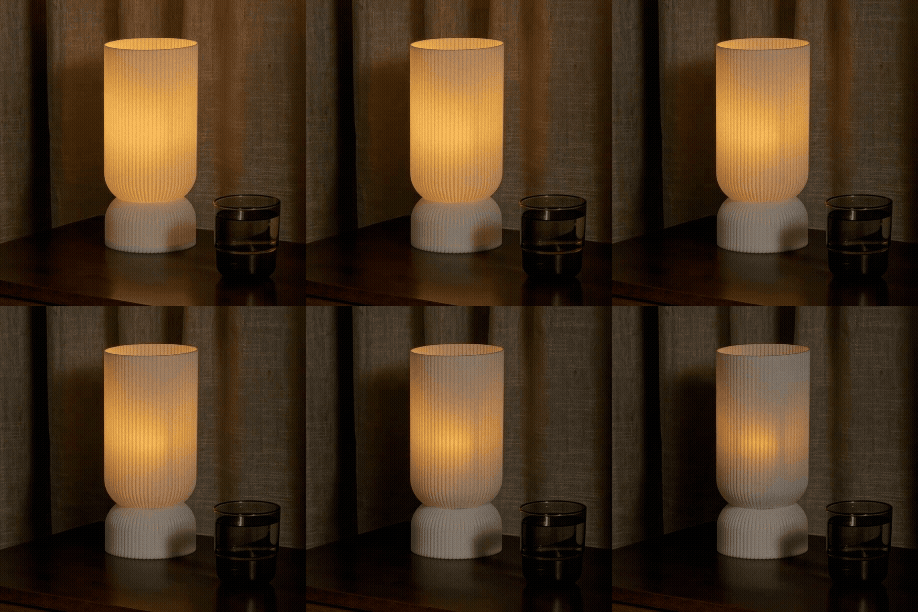
A dimmable, low-positioned source is best—but the quality of the light matters just as much as the control. Set low and warm (around 2200K) for a softened, diffused output.
TEMPERATURE (remove friction)
If your bedding doesn’t breathe, heat gets trapped, creating friction—whether you notice it or not. Over time, that becomes the thing the body keeps responding to.
Breathable fabrics remove that variable. The contact between your body and the fabric stays stable, and your system registers it. When it’s made well and cared for properly, it isn’t something you replace often—it’s something you rely on, night after night.
Get an organic sateen sheet set you can use nightly for years. There are also simpler cotton sets that still carry what matters: the ability to breathe, to soften over time, and to stay consistent against the skin. The experience doesn’t have to be excessive to be effective.
PRESSURE (create containment)
When the environment is mostly supportive, but something still feels off, then consistent, even pressure can help fill in the gap for you. A weighted blanket is the easiest way to introduce that sensation. It gives the body:
a stable boundary
predictable input
something to rest into

Nothing shifting. Nothing pulling attention. Just steady contact. The body will tell you quickly what weight works best for you. It should feel noticeable, but not restrictive.
What to look for:
around 8–12% of body weight
even weight distribution (no clumped filling)
breathable outer fabric
Other ways to introduce pressure
Not everyone needs full-body weight. Some bodies prefer targeted containment. For upper body release, an adjustable weighted shoulder wrap will place pressure where tension collects. Less intensity. More flexibility.
For grounding during daily activity, use a weighted lap pad as a strong daytime regulation tool. Lap pads provide steady pressure for working, reading, and decompressing without lying down.
Let the environment hold first
Weight is powerful, and it works best when the environment is already doing part of the work:
A room that’s slightly cool with breathable fabrics for your body.
Light that arrives gradually and lowers slowly.
Then the weight is added as the layer that allows everything else to settle.
Start with one shift.
Then build from there.

When the body is finally met
Some bodies don’t rest because they’re never fully met. Not by the space. Not by the surfaces. Not by anything consistent enough to allow them to feel safe enough to stop adjusting. When the environment becomes steady, the body follows.